
Why Your Trades Feel Uncomfortable: Understanding Emotional Trading in Forex Markets


You enter a trade and immediately feel it in your chest. You check your phone every few minutes. Every small move against you feels like a disaster, and every small move in your favour makes you want to close and grab the profit.
If that sounds familiar, you're not alone. Almost every trader feels this. The question is what that feeling is trying to tell you.
Why Trading Feels So Uncomfortable
Trading asks you to make decisions about an unknown future, with real money, while the result changes in front of you every second. Our minds are not built to enjoy that.
A few reasons it feels so hard:
• Losses hurt more than gains feel good. Researchers in behavioural finance have found that most people feel the pain of losing more strongly than the pleasure of winning the same amount.
• You can see every movement. Watching your profit and loss go up and down creates constant emotional ups and downs.
• There's no certainty. Even a perfect setup can fail, and part of you knows it.
What the Discomfort Is Telling You
Not all discomfort is the same. Sometimes it's a warning worth listening to.
Your position is too big.
If a normal price move makes your stomach turn, your lot size is probably too large for your account. Big positions create big emotions.
You don't have a clear plan.
If you're not sure where you'll exit, every tick feels like a decision. A clear stop loss and target remove that pressure.
The money matters too much.
Trading with rent money, school fees or savings you can't afford to lose turns every trade into a high-stakes moment.
Uncertainty is simply part of trading.
Sometimes discomfort just means you've accepted risk. That's normal. You can't remove it, but you can keep it small.
Quick Tip: Before entering, ask yourself: "If this trade hits my stop loss, will I be fine?" If the honest answer is no, reduce your size or skip the trade.
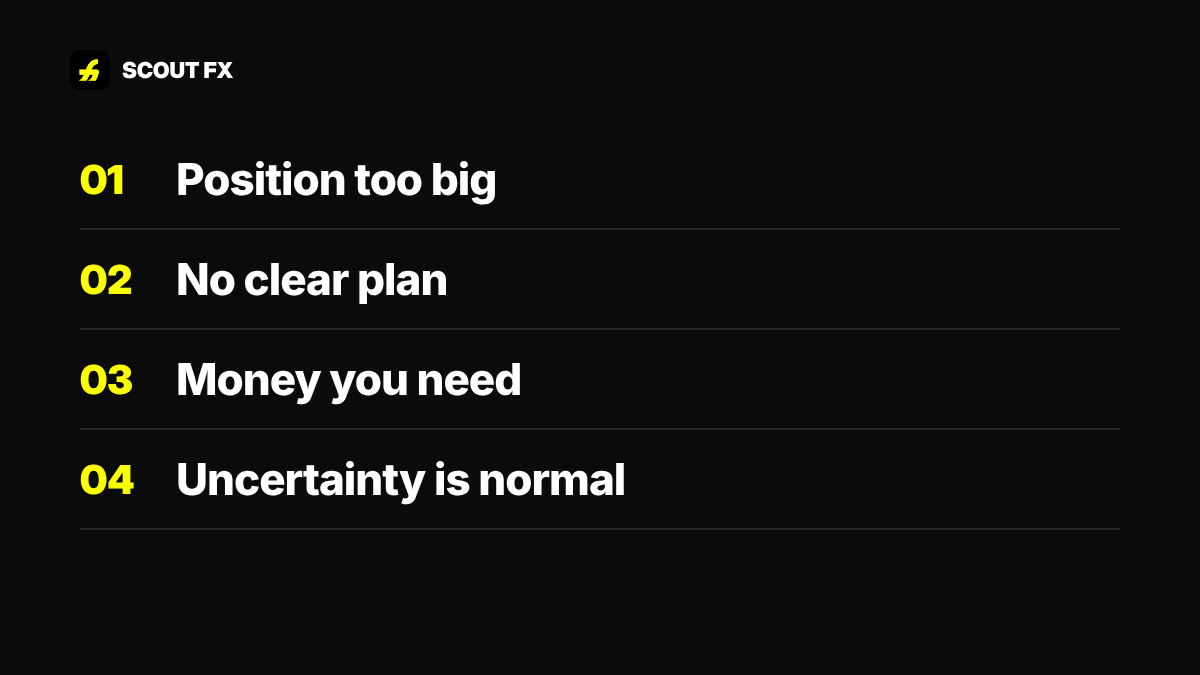
Discomfort during a trade often points to a problem you can fix before the next one.
Signs of Emotional Trading
• Closing trades early because you "couldn't take it anymore."
• Moving your stop loss to avoid taking a loss.
• Entering trades out of boredom or to "make back" a loss.
• Staring at charts for hours without a plan.
• Feeling your mood for the day depends on your trades.
How to Trade More Calmly
1. Risk less per trade. Keeping risk at 1% or less of your account makes each trade feel smaller, because it is.
2. Write the plan before you enter. Entry, stop loss, target and reason, all on paper or in your journal.
3. Set it and step away. Once your stop loss and take profit are in place, close the app for a while.
4. Trade fewer, better setups. Overtrading increases stress without increasing results.
5. Review, don't relive. Look at your trades once a day or once a week in your journal, not every minute.
6. Look after yourself. Poor sleep, hunger and stress make every decision harder.
Watch Out: If trading is affecting your sleep, your relationships or your ability to pay bills, take a break. No trade is worth your peace of mind.
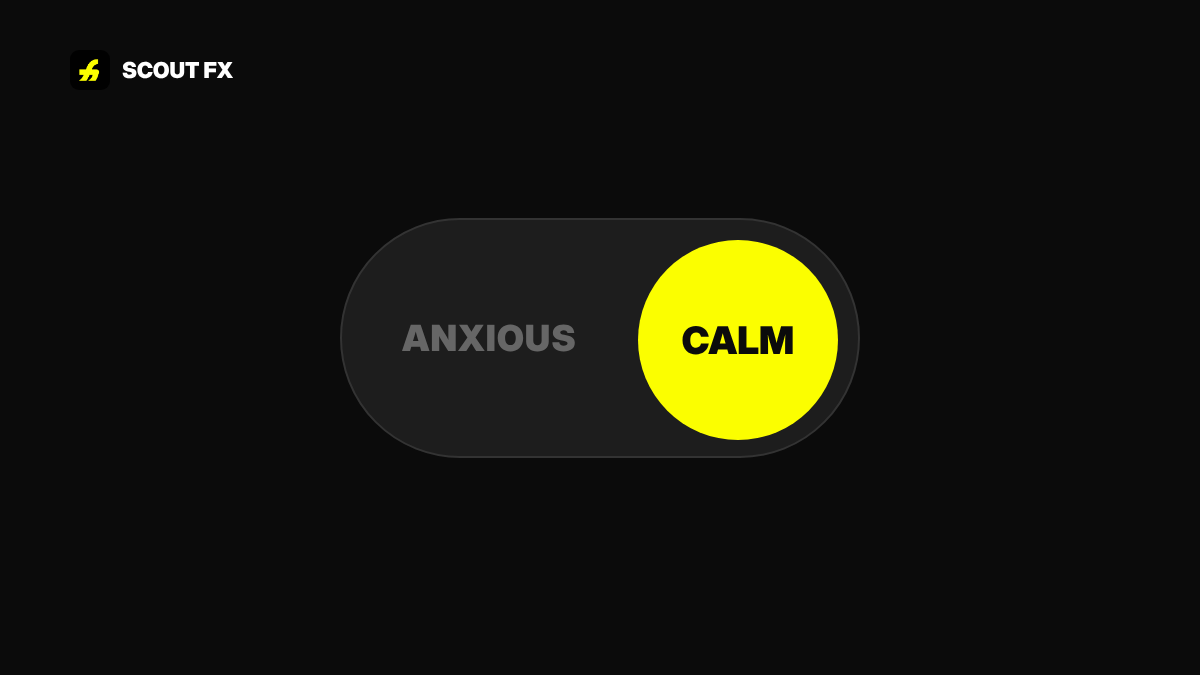
Smaller positions and a written plan help you move from anxious trading to calm trading.
Questions
Is it normal to feel anxious when trading?
Yes. Some discomfort is normal because every trade involves risk. Strong anxiety, though, is a sign to reduce your position size or review your plan.
How do I stop checking my trades all the time?
Set your stop loss and take profit, then set a specific time to check back, such as at the end of the session.
Why do I close winning trades too early?
Usually because of fear of losing your profit. Trading smaller and setting a take profit in advance can help you let trades run as planned.
Will trading ever feel completely comfortable?
Probably not, and that's fine. With experience and good risk management, it becomes steady rather than stressful.

Written by
Coach Emma
Founder and lead educator, Scout FX
Coach Emma founded Scout FX to teach trading the honest way: fundamentals first, risk before reward, and no get-rich-quick promises. Through free seminars, live sessions and the Scout FX community, Emma has helped more than 4,000 people across Ghana understand how the forex and gold markets really work.
This article is education, not financial advice or a trade recommendation. Trading forex, gold and crypto carries a high level of risk. Read the risk disclosure before you trade.