
Trading Psychology for Beginners: Why Greed and Fear Cost New Forex Traders Money


You can learn every chart pattern on YouTube and still lose money. Not because the strategy is wrong, but because of what happens in your head when real money is on the screen.
Ask experienced traders what was hardest about learning to trade and many will say the same thing: controlling themselves. This guide explains how greed and fear show up in forex trading and what you can do about them.
What Is Trading Psychology?
Trading psychology is the way your thoughts and emotions shape your trading decisions. It covers how you react to wins, losses, pressure and uncertainty.
Two emotions cause most of the damage:
• Greed, the desire to get more than your plan allows.
• Fear, the desire to avoid pain, even when your plan says to stay in.
Both feel reasonable in the moment. That is what makes them dangerous.
How Greed Shows Up in Trading
Greed rarely looks like greed. It looks like ambition or opportunity.
Holding past your target. You set a profit target. Price reaches it, but you think, "Just a little more." Then the market reverses and your winning trade becomes a loss.
Increasing your lot size after wins. Two good trades in a row and suddenly you feel unstoppable. You double your position. The next loss hurts twice as much.
Overtrading. You see opportunities everywhere and take trades that don't meet your rules, just to stay busy in the market.
The problem is not wanting more. It is letting that desire override your plan.
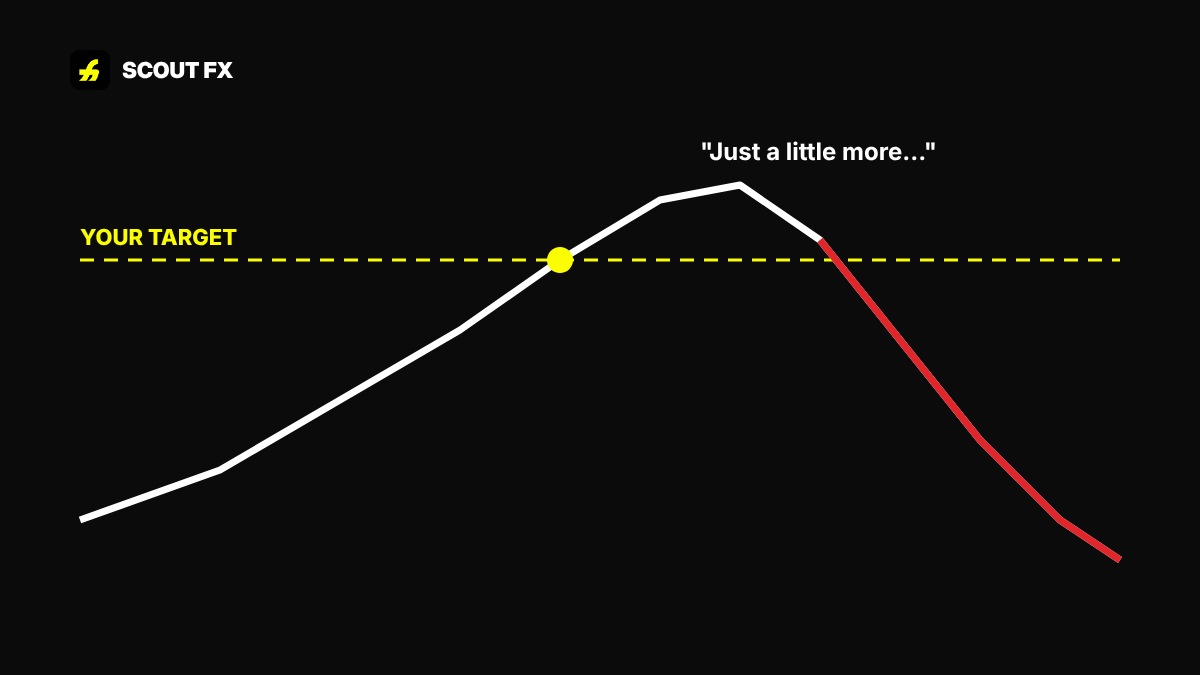
Greed often turns a winning trade into a loss when traders hold past their target.
How Fear Shows Up in Trading
Closing winners too early. A trade moves in your favour, but you panic at the first small pullback and close it for a tiny profit, missing the move you planned for.
Moving your stop loss. Price heads towards your stop, so you move it further away to "give it room." A small, planned loss becomes a big, unplanned one.
Freezing. After a losing streak, you stop taking valid setups, even when your plan says to enter.
Revenge trading. After a loss, fear of being behind pushes you to jump straight back in with a bigger trade to "win it back."
Why Emotional Trading Is So Common
Money is personal. For many young Ghanaians, the money in a trading account might be savings from an NSS allowance, a salary or a side hustle. Losing it doesn't feel like a number on a screen. It feels like losing time and effort.
Social media makes it worse. When everyone online seems to be winning, a normal loss can feel like failure, and that pressure leads to rushed decisions.
Quick Tip: If you feel your heart racing while a trade is open, your position is probably too big for your account or your nerves. Reduce your lot size.
Habits for Better Trading Psychology
You can't switch emotions off, but you can build habits that keep them in check.
1. Write a trading plan. Decide your entry rules, exit rules and risk per trade before the market opens, not during a trade.
2. Set your stop loss and take profit first. Make the decision when you are calm, then let the trade play out.
3. Risk a small, fixed amount. Many traders risk 1 to 2% of their account per trade. Small losses are easier to accept.
4. Keep a trading journal. Write down why you entered, how you felt and what happened. Patterns will appear quickly.
5. Set a daily limit. Stop trading for the day after a set number of losses, for example two.
6. Step away after big wins too. Overconfidence after a win is just as risky as frustration after a loss.
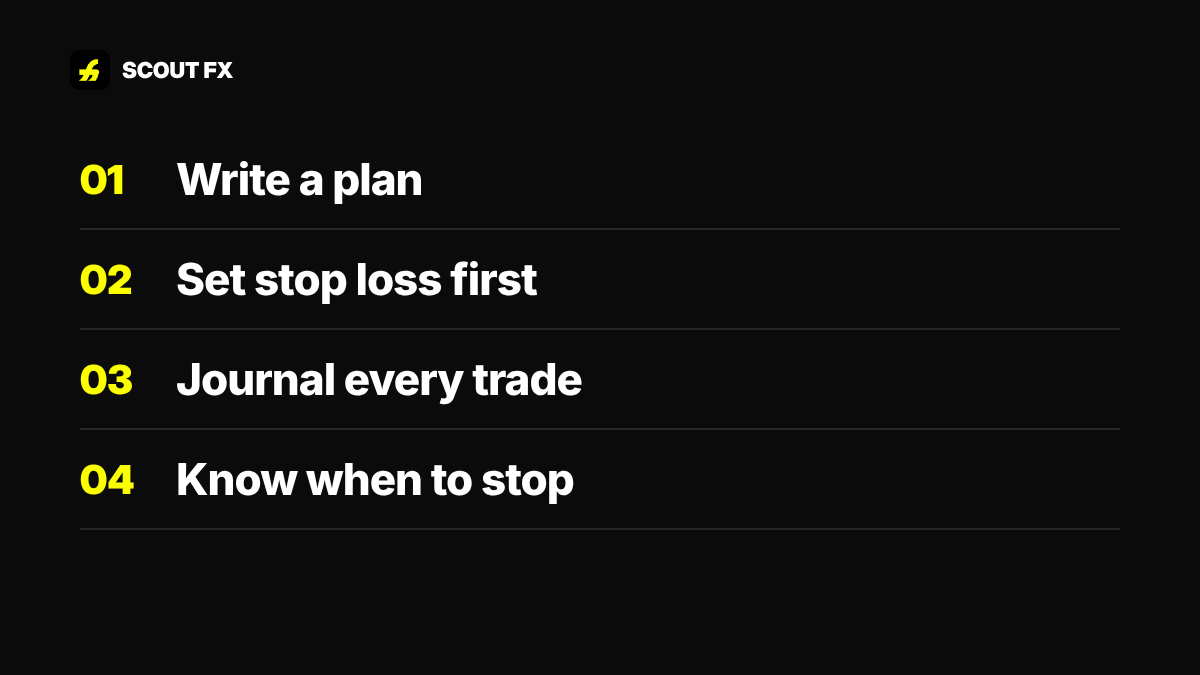
Simple habits help you trade with your plan, not your feelings
Questions
Why do I keep closing my trades too early?
Usually because of fear of losing what you have gained. Setting your take profit in advance and trading smaller can help you stay in planned trades.
How do I stop revenge trading?
Set a rule to step away after two losses in a row, and only return the next day after reviewing your journal.
Can a demo account help with trading psychology?
It helps you build habits, but demo trading feels calmer than live trading. Start live with very small amounts to get used to real emotions.

Written by
Coach Emma
Founder and lead educator, Scout FX
Coach Emma founded Scout FX to teach trading the honest way: fundamentals first, risk before reward, and no get-rich-quick promises. Through free seminars, live sessions and the Scout FX community, Emma has helped more than 4,000 people across Ghana understand how the forex and gold markets really work.
This article is education, not financial advice or a trade recommendation. Trading forex, gold and crypto carries a high level of risk. Read the risk disclosure before you trade.